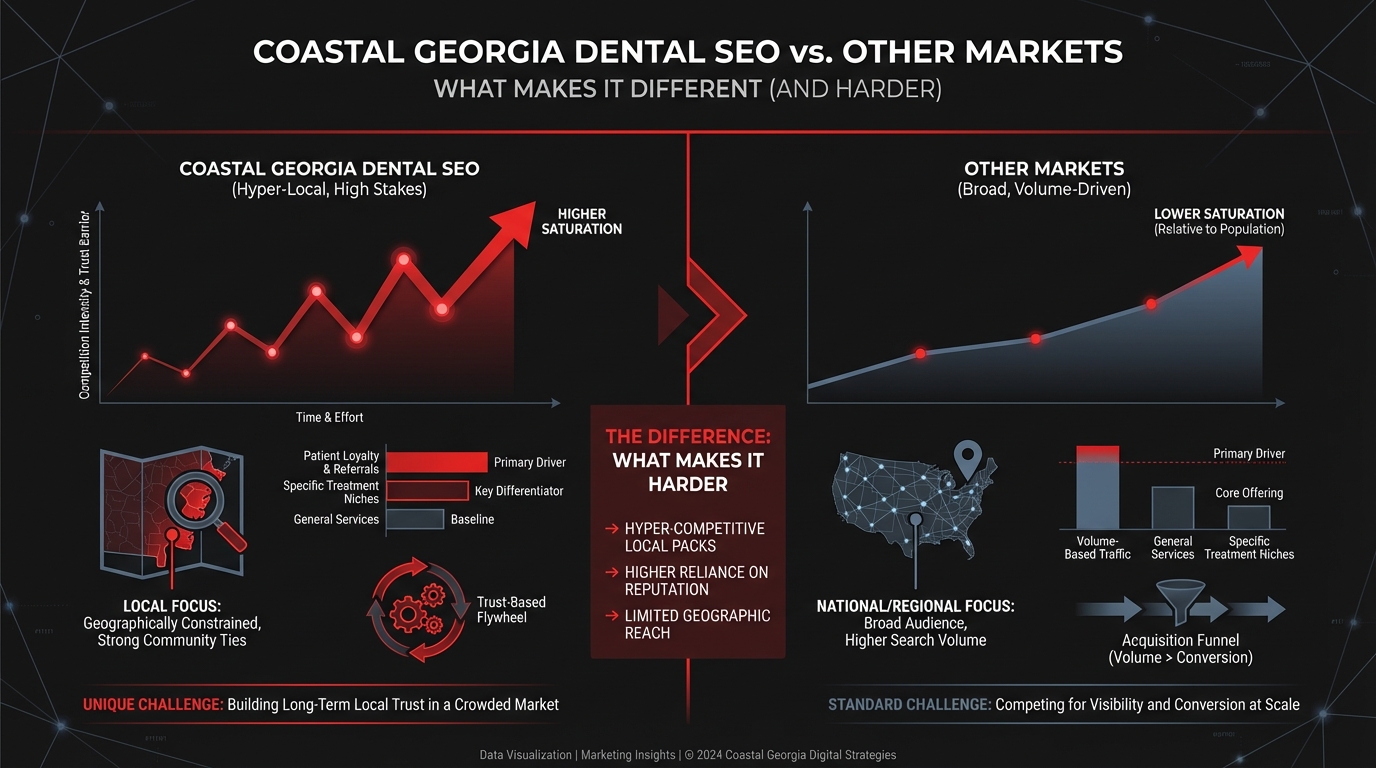
If you've ever tried to apply standard dental SEO advice to a practice in Savannah, Brunswick, or St. Simons Island — and wondered why the results feel inconsistent — you're not imagining it.
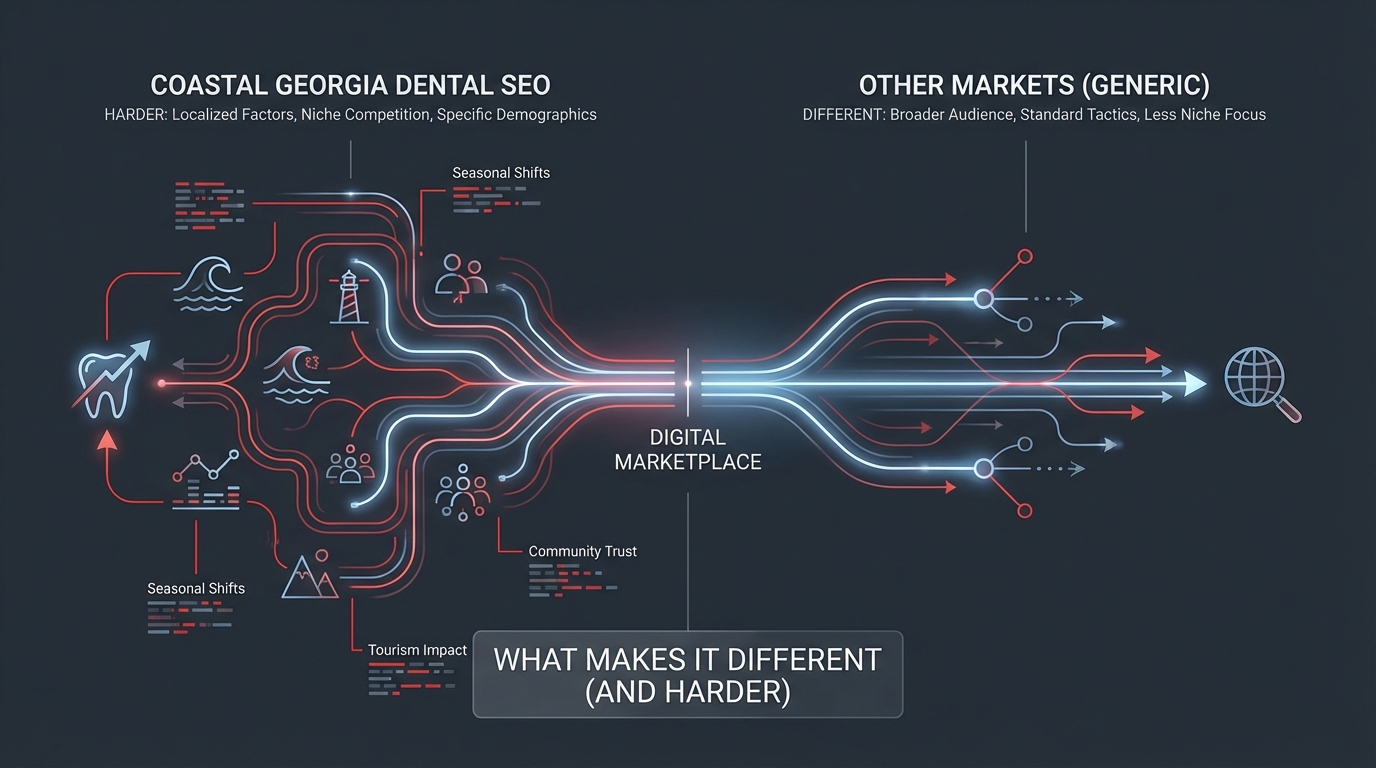
Coastal Georgia doesn't behave like Atlanta. It doesn't behave like Charlotte or Nashville either. The SEO playbook that works in a major inland metro will get you partial results here, and in some areas, actively mislead you about what's actually happening.
This post breaks down what makes coastal Georgia SEO different, where the standard playbook breaks down, and what you should actually be doing instead.
The Coastal Georgia Market: Three Cities, Three Different Problems
Let's define the geography first, because "coastal Georgia" isn't monolithic.
Savannah is the anchor — a mid-sized city of 150,000+ with a growing healthcare sector, an active military community (Fort Stewart / Hunter), significant SCAD enrollment, and steady population growth in suburban corridors like Pooler, Richmond Hill, and Rincon. It behaves somewhat like a normal mid-market — but with tourist seasonality layered on top.
Brunswick is a smaller city of 25,000–30,000, functioning more like a regional hub for the surrounding Golden Isles area. It's home to a mixed demographic: long-term residents, retirees, and working-class families. It's not a heavy tourist town itself, but it serves as the commercial center for visitors flowing toward the islands.
St. Simons Island (and adjacent Sea Island and Jekyll Island) is where the tourist and seasonal resident dynamic gets extreme. Year-round population sits around 15,000, but the island swells to multiples of that in summer. Many "residents" are vacation homeowners. Healthcare behavior here is transient by nature.
Each market requires a different SEO orientation. Treating them the same is the first mistake most practices make.
Challenge 1: Seasonal Search Volume Swings
In markets like Atlanta or Charlotte, search volume for terms like "dental implants near me" or "emergency dentist" is relatively stable month over month. There are fluctuations, but nothing dramatic.
In coastal Georgia, especially St. Simons and Savannah, you'll see meaningful spikes in certain periods — spring break, summer tourist season, and the fall "snowbird" migration when northern retirees arrive for extended stays. You'll also see winter troughs when the tourist population thins and some seasonal residents head back north.
What this means for SEO:
- Seasonal content strategy: Publish content ahead of the traffic waves, not during them. If you want to rank for "dentist St. Simons Island" by June, you need that content live and indexed by March. Google takes weeks to rank new pages — plan accordingly.
- Google Business Profile post timing: Increase GBP posting frequency in the 6–8 weeks before peak season. Fresh activity signals help you compete when search volume spikes.
- Ad budget allocation: If you're running Google Ads alongside SEO, front-load your budget into high-season months. Organic rankings take time; paid search can fill the gap.
- Don't panic in the trough: Winter traffic drops in coastal markets are structural, not a sign that your SEO broke. Track year-over-year, not month-over-month, to assess true performance.
Challenge 2: The Transient Population Problem
Here's something almost no dental SEO guide mentions: a significant percentage of patients in coastal Georgia markets aren't looking for a long-term dental home. They're tourists with a broken tooth. Military families rotating in for 18 months. Retirees wintering on St. Simons for four months out of the year.
This creates a specific problem: high search volume, low lifetime value per patient.
Transient patients generate real appointments — emergency visits, urgent care, cleanings — but they don't build the consistent base of recall patients and high-value treatment cases that drive sustainable practice revenue.
How to manage this strategically:
- Differentiate your content signals. Write content and optimize specifically for high-intent, high-value searches that are more likely to attract permanent or long-term residents. "Dental implants in Savannah GA" is more likely to attract a Pooler resident with a real budget than "emergency dentist Savannah." Both are worth capturing, but be intentional about which you prioritize.
- Capture emergency patients for long-term conversion. When a transient patient comes in for an emergency visit, that's a conversion opportunity. Build a post-visit sequence: follow-up email, treatment recommendation, referral request. Some percentage will refer local friends or return when they're back in the area.
- Local vs. tourist landing pages. For St. Simons practices especially, consider separate content angles: one targeting year-round residents ("your local dental home"), one targeting seasonal visitors who might need emergency or urgent care during their stay. Different intent, different messaging, different keywords.
Challenge 3: Google Maps Visibility in Low-Density Areas
In Atlanta, there are enough dental practices per square mile that the Google Maps competition is fierce and well-understood. In Brunswick or St. Simons, you're dealing with the opposite problem: relatively few practices, lower review volumes, and a Maps algorithm that can behave unpredictably in sparse markets.
Specific issues:
Service Area Bleed
In a low-density coastal market, your Google Business Profile may rank for searches across a much wider geographic area than you'd expect — or conversely, get overridden by Savannah practices that have more reviews even though they're 70 miles away. This is especially true for specialty terms like "dental implants" or "oral surgeon."
Fix: Claim your geographic territory aggressively with location-specific content. A page titled "Dental Implants in Brunswick, GA" with genuine local content (referencing local neighborhoods, landmarks, the patient community) signals to Google that you are the local authority — not a Savannah practice with more reviews.
Review Velocity Matters More Than Volume
In a market where your top competitor has 80 reviews and you have 45, closing that gap matters enormously — far more than it would in a 500-review vs. 600-review Atlanta competition. A small coastal market practice can move from #3 to #1 in the map pack by adding 20–30 reviews over 60 days.
Fix: Implement a systematic review request sequence. Every patient who leaves satisfied should receive an SMS or email with a direct link to your Google review form within 2 hours of their appointment. Make it friction-free — a single tap to the review prompt. Set a goal of 5 new reviews per month minimum.
Photo Differentiation
Practices in coastal markets have a visual advantage they underutilize. St. Simons Island practices can feature photos of their proximity to the coast, local landmarks, the unique character of the island community. Savannah practices can showcase the Historic District, Forsyth Park, the architectural beauty of the city. These images stand out in the Google Maps listing photo carousel against generic stock dental photos.
Fix: Commission a professional photo session once a year. Include exterior shots with local context, interior warmth, and team personality. Upload 5–10 new photos per month to signal active profile management.
Challenge 4: Reputation Management in a Small Town
Word of mouth travels differently in coastal Georgia than in a large metro. In Savannah, patients might not personally know their dentist's previous patients — but in Brunswick or St. Simons, they very well might. Negative reviews hit harder in small markets because the reviewer and the reader often share social networks.
This cuts both ways: a well-managed practice reputation can generate referral loops that don't exist in anonymous big cities.
Reputation strategy for coastal markets:
- Respond to every review — positive and negative. Response rate matters for Google ranking, and it matters even more for conversion when prospective patients are reading reviews. A thoughtful, professional response to a negative review does more to reassure fence-sitters than 10 positive reviews without responses.
- Don't respond defensively. A negative review that you respond to aggressively looks worse than the original review. Acknowledge, apologize for the experience, invite them to contact you directly. Nothing more.
- Build review diversity. Google Maps reviews are the priority, but Yelp, Healthgrades, and Facebook reviews matter too — especially for patients using those platforms first. In a small market, having 50 Google reviews and nothing elsewhere can look thin.
- Monitor mentions. Set up a Google Alert for your practice name. In a tight community, local Facebook groups, Nextdoor, and neighborhood forums can generate mentions that shape your reputation in ways you don't see in your reviews dashboard.
Practical Recommendations by Market
Savannah
- Prioritize Google Maps optimization and organic ranking for suburban corridors: Pooler, Richmond Hill, Rincon. These areas are growing fast and are underserved in dental search results.
- Content focus: High-value treatment keywords (implants, cosmetic). The patient population can support it.
- Review goal: 10+ new Google reviews per month. The competition is real enough that review velocity matters.
Brunswick
- Focus on being the clear #1 local choice. You don't need to outrank Savannah — you need to dominate "dentist Brunswick GA" and adjacent terms.
- Build referral relationships with the island communities (St. Simons, Jekyll) who may come to Brunswick for dental care.
- Content focus: General dentistry + specialty (implants, family dentistry) with local flavor.
St. Simons Island
- Accept the transient patient reality and build a dual strategy: long-term residents (high-value treatment) and seasonal visitors (emergency, urgent care, cleanings).
- Optimize for both "dental implants St. Simons Island" and "emergency dentist Golden Isles."
- Seasonal content cadence is critical here more than anywhere else in the region.
Challenge 5: Content Strategy That Reflects the Market
Standard dental content advice tells you to blog about treatments: "What Are Dental Implants?" "Invisalign vs. Braces." That content has its place, but in coastal Georgia, you need a layer of locally anchored content that generic competitors can't replicate.
Local content ideas that work in this market:
- Community content: "Your Guide to Dental Care in the Golden Isles" — covering what's available, how to choose a provider, what to expect if you're new to the area. This targets relocators and seasonal residents searching for orientation.
- Seasonal content: "Planning Dental Work Around Your Winter in St. Simons" — targets snowbirds who want to schedule treatment during their extended stay. This is high-intent content with very low competition.
- Military-focused content: "Dental Care for Fort Stewart Families: What TRICARE Covers" — directly relevant for Savannah-area practices near the military installations. This captures a specific, high-volume segment with financing questions.
- Neighborhood pages: Individual pages for Pooler, Richmond Hill, Rincon, Jekyll Island, Sea Island — each with genuinely distinct local content, not just the city name swapped out.
The practices that commit to local content depth build a moat. A Savannah practice with 15 pages of locally relevant, well-written content is almost impossible for a generic DSO to outrank for local searches — because the DSO won't invest in that level of local specificity.
The Meta-Point: Coastal Georgia Needs Local Intelligence
Generic dental SEO playbooks are built for average markets. Coastal Georgia isn't average — it's seasonal, transient in pockets, small-community in culture, and geographically distinct in ways that change how Google's local ranking signals work.
The practices winning local search here aren't the ones with the biggest budgets. They're the ones who understand their specific market dynamics and build their digital strategy around them.
Ready to build a high-value patient pipeline? Book a strategy call with Closing More Cases