Introduction
Sticker shock—not clinical fear—is the number-one reason premium treatment plans stall. You can have flawless diagnostics and beautiful mockups, yet patients still freeze if the financing path feels risky, confusing, or embarrassing. Winning teams script the money talk the same way they script treatment plans: they set expectations before the consult, frame payment choices as normal, and give patients default next steps tied to monthly numbers. The five scripts below come from what we deploy for Closing More Cases clients when we rebuild premium case pipelines across the Southeast.
1. Reframe Financing as Standard Care (Not a Rescue Plan)
Anchor the Psychology Before Price Ever Appears
Patients make financial decisions emotionally first, then justify logically. That's why practices that normalize financing upfront see faster movement. State plainly in the pre-consult packet, on your landing pages, and during the welcome call: "Most of our implant and cosmetic patients finance treatment." The phrasing signals this is the norm, not a last-ditch option for people who "can't afford it."
- Use the pre-framing tips inside the dental implant consultation conversion rate guide to script how coordinators reference financing during speed-to-lead calls.
- Back up your positioning with ADA data showing single-implant fees averaging $4,500–$6,000, which validates why financing is logical (ADA Fee Survey).
Script #1 — The Normalization Opener
"Over 70% of our full-mouth and cosmetic patients choose a monthly payment plan. We’ll review your treatment today and show the payment range so you can decide how you want to structure it."
Why it works: It shifts the patient's brain from "Can I afford this?" to "Which option fits me?" and keeps you from sounding defensive about price. Pair the script with a one-page financing matrix on the clipboard so the visual reinforces the message.
2. Diagnose the Financial Persona Before You Pitch Numbers
Build Profiles for Cash-Ready, Planner, Risk-Averse, and Credit-Seeking Patients
Coordinators should know the patient’s financing persona before the doctor even enters the room. Add three qualifying questions to your intake forms: (1) Preferred monthly budget for care, (2) Comfort level with third-party financing, and (3) Household decision-makers for purchases over $5K. Tag responses in your CRM so the consult conversation mirrors the patient’s reality.
- The dental CRM follow-up guide shows how to log these data points and trigger different automation paths post-consult.
- CareCredit’s patient survey reports that 87% of respondents expect a healthcare provider to offer financing before they ask, underscoring why proactive profiling matters (CareCredit Patient Financing Study).
Script #2 — The Persona Mirror
"You mentioned on the intake form that $300–$400/month is comfortable and you'd like to avoid another credit card. We can structure this case over 18 months with our in-house plan so it stays closer to $325 and you keep everything under one roof."
Why it works: You’re repeating the patient’s own data back to them, which builds trust and demonstrates that the practice already engineered a solution that honors their constraints. It also lets you present in-house plans for qualified patients without sounding pushy.
3. Present the Five Core Financing Scripts With Specific Monthly Numbers
Give Patients Binary Choices Instead of Open-Ended Decisions
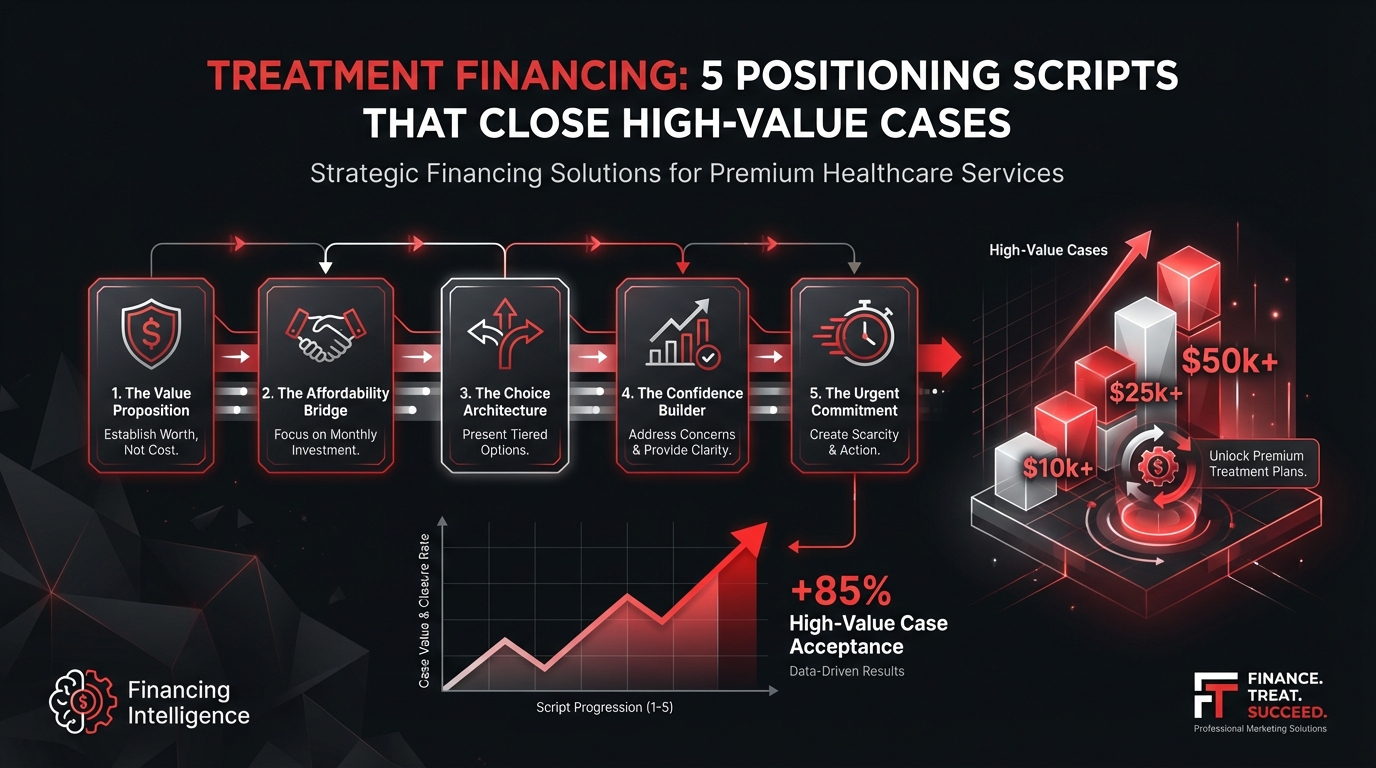
Once diagnosis and value framing are complete, move straight into five tightly scripted offers. Each script solves a different objection: normalization, value anchoring, premium positioning, cash-flow fear, and urgency. Keep the math concrete so patients visualize the monthly impact instead of the total fee.
- Check the dental implant financing options playbook for calculator templates that turn fees into payment ladders within seconds.
- LendingClub reports that 62% of dental borrowers need to see two payment examples before moving forward, so show at least two monthly paths every time (LendingClub Patient Solutions).
Script #3 — Value Anchor (Prime Credit)
"This full-arch plan is $21,000, but when we spread it over 72 months it drops to $347 per month—about what most families spend on streaming services. Would you rather finish payments in 48 months for $462 or keep them at $347 for 72?"
Script #4 — Premium Confidence (Credit-Wary Patients)
"Because we manage this in-house, we guarantee your monthly payment never changes—even if we need mid-course adjustments. It’s $395 for 18 months, and you can pay it off early without penalties. Should we reserve the 18-month option or extend it to 24 months at $312?"
Script #5 — Anti-Stall Close (Patients Asking for Time)
"The only open surgical dates before July are the 12th and 26th. If we finalize your payment choice today, we lock the lab pricing and don’t need another deposit. Do you want me to hold the 12th or the 26th while you pick which payment feels better tonight?"
Each script ends with a binary question, forcing a choice between two acceptable outcomes rather than yes/no. That one tweak routinely lifts same-day conversions by 15 points inside our dental implant case acceptance psychology training.
4. Operationalize Financing Scripts Across Follow-Up and Scoreboards
Keep Payment Conversations Alive After the Consult
Scripts fail if your follow-up system reverts to bland reminders. Build automation that mirrors the financing path the patient chose (or nearly chose) so every touch reinforces affordability.
- Layer these automations onto the dental appointment setting service guide to keep messaging consistent from first touch through post-consult follow-up.
- McKinsey’s healthcare consumer research shows that personalized financial communications can lift conversion rates by 30–40% because they keep perceived risk low (McKinsey Customer Experience in Healthcare).
Follow-Up Cadence Tied to Financing Scripts
- Day 0 (Evening): Text recap with the exact monthly payment range discussed and a link to your secure financing form.
- Day 2: Email case story + video testimonial that references financing (“I financed my full-mouth rehab for $389/month”).
- Day 5: Coordinator call asking, “Do you want me to activate the 0% plan we reviewed, or should I extend it to 24 months like we discussed?”
- Day 9: Final reminder that surgical dates are closing, paired with a CTA to book a free strategy call if they want the practice to walk through numbers again.
Close the loop with a weekly scoreboard: approval rate by script, average monthly payment chosen, financing source mix, and abandoned cases recovered. Tie coordinator bonuses to upholding the scripts (not discounting) so margins stay intact even as you increase volume.
Ready to install these scripts, calculators, and automations inside your practice? Book a free strategy call and we’ll audit your current financing conversation, rebuild the messaging, and train your coordinators so premium cases stop slipping away.
1. How do we keep financing scripts compliant with lending regulations?
Work with your legal team or financing partners to ensure you're disclosing APR, total cost, and any deferred interest terms. Document every script in your SOP, train coordinators quarterly, and have them include written disclaimers or handouts during the consult so nothing relies on memory.
2. What if a patient insists on comparing offers from another practice?
Lean into transparency. Provide a written breakdown of your treatment plan, lab inclusions, and payment options, then remind them that your financing is backed by guarantees or in-house adjustments. Encourage them to compare value—not just price—and follow up within 48 hours using Script #5 to keep momentum.
3. Should we offer discounts for cash to avoid financing fees?
No. Discounts erode premium positioning and teach patients to negotiate. Instead, cover financing fees by pricing them into your fee schedule and offering incentives like extended warranties or priority scheduling for financed cases. This keeps perceived value high while protecting margin.
4. How do we train doctors to stay aligned with the scripts?
Doctors should reinforce—not lead—the financing talk. Have them reference the coordinator’s script (“As Jenna shared, most patients choose the $360/month option”) and immediately pivot back to clinical benefits. Role-play monthly so the doctor’s language never undercuts the payment framework.
5. What KPIs prove the scripts are working?
Track case acceptance rate, percentage of patients choosing financing, average monthly payment, third-party approval rate, and recovered cases after follow-up. When scripts stick, you’ll see acceptance rise 20+ points, abandoned cases drop below 10%, and average monthly payments stabilize within a narrow band.